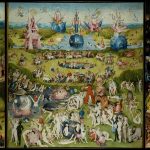
“The Garden of Earthly Delights” by Hieronymus Bosch (1490-1510)
I had searched far and wide, and at the end of a long road realized: Heaven is a world hollowed out of infinity.
It’s the one sentiment I keep coming back to, years after I first thought of it. Every few years, it speaks another one of its secrets to me, and I find myself where I started, and I “know the place for the first time.”
For now, for this instance, it brings to mind a recurring thought. That somewhere in the last few years, I stopped being able to wait for the kettle to boil.
Ninety seconds. That’s all it takes for it to work its magic of currents and moving energy. Time it was it would’ve taken us minutes, if not hours, to make tea. Now, the water goes in, you press a switch, and there it is: The minute and a half of nothing particular to do except stand at the counter and look at the wall. Maybe worry about that bill you were supposed to pay last weekend or the car that’s in need of a good wash.
But that’s just it. It turns out that I have not stood and looked at the wall in a very long time. What happens instead is that my hand goes into my pocket, and by the time I realize what I’m doing, I’ve spent quite a few minutes consuming some quality content in my feed.
Then I’m at the doctor’s office. The secretary pens down my name, asks me to take a seat and wait until it’s my turn. She calls my name abruptly, and I am pushed out of my reverie, having half-watched that YouTube video that I’d saved for later.
Then I’m in the taxi. I take a look around and see the woman sitting on my right, but I don’t stare. I look outside the window and see everybody going this way and that like their tails are on fire. The noise is exhausting. Just as I notice that a car almost collided with a motorcycle on the other side of the street (cue the cursing and the shouting) my hand is going through a familiar motion. Then I look down and there it is, again. A few minutes later, I’ve laughed at a meme. I’ve watched the president make a fool of himself yet again. I’ve seen a desk lamp in the shape of a fire-breathing dragon, on sale. Yes, that one is going to be saved for later. There were a few others, and for the life of me I could not tell you a single thing that was in them now.
I reckon that’s the part that bothers me most. Not the hand reaching into the pocket like it’s a ritual. The not remembering.
Today, I’m taking you on a whirlwind of a ride. I want to tell you about a bird, about a Roman, and about what happens in your head during those ninety seconds you are no longer looking at the wall. I’m building the case slowly, because I think the fast version of this argument — the one that everybody’s selling — is wrong, and in more ways than one.
In roughly 65 AD, the Stoic philosopher Seneca sat down to write a letter to his friend Lucilius, and the thing he chose to complain about was that there were too many books.
The multitude of them, he wrote, distracts you — distringit librorum multitudo — and a person who reads everywhere ends up nowhere. “Nusquam est qui ubique est,” he wrote, literally: “He who is everywhere is nowhere.”
This is comforting in an odd sort of way, because it suggests the human attention span is not something we’re debating now. No, it has been under complaint since the invention of the codex, and every generation that has ever felt like their minds didn’t belong to themselves has done so in good company. Blaise Pascal, sixteen hundred years later, decided that all of humanity’s problems came down to our inability to sit quietly in a room alone. Kierkegaard, the great connoisseur of dread and melancholy, thought boredom was the root of all evil, and that the entire history of human civilization was a series of increasingly elaborate strategies for avoiding it.
It’s easy to miss, but Seneca was describing a human tendency, not an industry. Nobody in 65 AD was employing behavioral scientists to make scroll algorithms harder to put down. We have been prone to wander the fields of our consciousness for as long as we have breathed. What’s new is that somebody found the equation that tendency runs on — and I mean that in the literal sense — and started tuning it to serve at the altar of the golden yoke, the mercantile order, the Mammonism on whose whim our world turns.
To see the tuning, let’s turn to the equation.
In 1961, the psychologist Richard Herrnstein put pigeons in a box with two buttons. The birds distributed their pecks between the two buttons in almost exact proportion to the rate of the reward each button paid out. The total reward was irrelevant; the birds only paid attention to the rate, so twice the payoff rate, twice the pecking. This is sometimes referred to as the matching law, and it holds reliably across species — pigeons, rats, monkeys, undergraduates, you.
Herrnstein later called it melioration, from the Latin for “making better,” and what it describes is a creature that constantly moves towards the option that is paying better right now. With melioration, you optimize locally and get robbed globally. Think about an evening you regret. About the sequence of choices that led you to the end of it. Each choice might look reasonable and justifiable individually, but stack them together, with hindsight, and you have a night you regret. Every peck was rational when you did it, but it added up to a disaster.
Science seems to imply that the gap between what you do and what you’d have chosen isn’t necessarily a character failing, but how choice works in animals with nervous systems. That might have been a relief under different circumstances, but not when it’s a properly that could be exploited if you were building something to hold people’s minds hostage.
A bird lands in a bush full of berries and starts eating. The first berries are easy, but the ones that remain are fewer and further apart. The rate of return is constantly falling as the bush depletes. At some point it should leave for the next bush, but flying costs time, during which the bird eats nothing.
Ecologist Eric Charnov said that one should leave the patch when their rate of return inside it drops to the average rate of the whole environment, travel time included. So, not when the bush is empty, and certainly not when you’re bored. When your marginal yield falls to what you could be getting out there on average, that’s when you leave the patch. This is the Marginal Value Theorem — “marginal” meaning the value of the next berry rater than the total.
It is linear and drawn out, from the moment you start doing something, and it ends when you touch the curve at the cue signal. That point is when you decide to go. It’s a law of nature. A constant of physics. It is embedded into the very fabric of the world we inhabit. Nearly every foraging animal on earth adheres to this rule without discerning it exists.
And in 1999, Peter Pirolli and Stuart Card, two scientists working at Xerox PARC who invented the modern computer screen, pointed out that we do this with information too. They called it information foraging; the fact that we move through information in patches. A page, an article, a results list, a headline, a thumbnail, the phrasing of a link, all of which allow us to assign value to things we haven’t reached yet.
Except, patches deplete and the curve eventually bends, but if your rate of return inside the patch doesn’t fall, the dynamic changes altogether. Now, the leave signal never fires.
The feed is a bush that does not empty. There’s essentially no last berry, no page two, no diminishing returns, no bottom of the pile. The very stopping cues we rely on for our decision-making on a day-to-day basis, what evolution has fostered in all animals, simply do not exist in that environment. Now add this to the fact that the ranking algorithm’s entire job is to keep your local rate of return from falling.
Combine the two halves of the equation. The matching law says you’ll drift toward whatever pays best right now. The Marginal Value Theorem says you compare that to the average rate of your whole environment.
What is the rate at second one of opening a book you want to read? You’re decoding names, finding your footing, trying to focus so you can absorb the text, all the while being mildly bored. Now what is at second one of the feed, one engineered to be high from the get-go? A meliorating creature takes the feed every time. And it can do that while sincerely, profoundly, wishing to have read the book instead.
In a study conducted by two Stanford economists in 2022, they gave people the option to pay for commitment devices aimed at limiting their social media use, and they actually bought them. What really strikes one as odd is you do this with an activity you simply enjoy. You don’t pay money to be prevented from seeing your friends. But all of that only explains the hand reaching and the phone holding. Let’s go back to the kettle.
We’ve heard the phrase being idle too many times, but the brain does not actually idle.
In 2001, the neurologist Marcus Raichle and colleagues noticed something odd in brain imaging data. A set of regions that got less active when people did tasks, and lit up when they were left alone doing nothing. You’d think the inverse was true, but that’s because the thought process is not entirely conscious. When nothing external is demanding attention, the brain goes into something called the default mode network.
This is essentially what “having a mind” is all about. It’s about autobiographical memory. It’s thinking about the future. It’s thinking about people. It’s self-referential thought. And it all runs in the gaps. Since the late 2000s, a line of research on waking rest has been building, and the core finding is that if you learn something and then rest quietly for a few minutes, you remember it measurably better than if you’d immediately done something else.
Erin Wamsley, reviewing the field in Trends in Cognitive Sciences, concluded that in everyday life, moments of unoccupied rest may serve as essential cognitive function. The process not only gives you a sense of linearity, but also a lifeline to your memory and what you deem too important to simply forget or leave behind in the dustbin of every tiny stratum and wave of information you are bombarded with every second.
The proposed mechanism works in two parts. The first is replay. During quiet rest, the hippocampus — the structure that handles new episodic memory — reactivates the pattern of the thing you just experienced over and over. It rehearses and copies your new fragile memory into something more durable. You’re not aware of any of this, but your brain is filing the information and the memory all the same.
The second is retroactive interference, which is the fancy name for a very old idea in this field. That you consume content doesn’t stop this process, but new incoming material disrupts the consolidation of material you just took in. The filing needs a quiet room.
Think of it like this. You’ve just finished watching an amazing movie. You think it’s an experience that should stick with you for the rest of your life. If you immediately walk your brain out of that movie and into a feed, a conversation, anything that requires attention and provides information to process, that won’t be a neutral link in the environment, because it will then compete with the movie and scatter the filing process.
The ninety seconds I stared at the wall as the kettle boiled was the breathing room my brain had to catalogue and remember what came before it. Now, that interval is gone. So it was when I visited the doctor’s office. And again when I was in the taxi. It happens practically every few minutes when an agitated soul reaches inside their pockets to fill the vacuum.
Naturally, the philosophers got there first, and they did it, as they generally do, without scanners or fancy tech.
There’s a passage in the Daodejing by Laozi about thirty spokes sharing a single hub, and clay shaped into a pot, and a room cut with doors and windows. In each case the material is not what makes the thing useful. The hole in the hub is what lets the wheel turn. The empty space inside the pot is what holds the water. We work with being, and non-being is what we use.
Augustine, in Book XI of the Confessions, is trying to work out what time actually is. He says that he knows and understands exactly what it is, until somebody actually asks him. He postulates that time is a thing the mind does, that past and future exist as memory and expectation. It’s a fourth-century way of saying that continuity is not out there in the world. Continuity is manufactured inside our brains.
Another great quote is from Walter Benjamin, who wrote that: “boredom is the dream bird that hatches the egg of experience.”
The Greeks had the cleanest take of them all. Aristotle’s word for leisure was scholē, which is where we get “school.” His word for work — for business — was ascholia. Literally: un-leisure. In the Greek, work is defined as the absence of the thing that matters, rather than the reverse. We have reversed the polarity of that sentiment entirely.
Look at what English gives us for the interval: Downtime, dead time, idle, killing time. Every word we have frames it as absence, a hole where something ought to be. You can’t ask people to protect their dead time, because the phrase already admits defeat. Instead, we filled it with the only thing we had a positive word for: entertainment. To entertain is to hold — to keep someone occupied, to take up the space between now and whatever comes next. At least that word was honest, but that’s not how we heard it.
If I stopped here, you’d have a clean and satisfying argument, and I’d be doing the thing this genre does every time, which is to run a plausible argument into a sweeping declaration and presume to have fixed everything that’s wrong with our society today. If this were a video essay, I’d even end it with a dramatic silence, letting you stare into the dark void of your own opacity as you realize what has been done to us.
Alas, my inquisitive nature gets the better of me.
So, let’s do a little bit of speed fact-checking, to gauge where we stand. People claim attention spans are shrinking, and the famous version of this — the eight-second span shorter than a goldfish — is entirely fabricated and has no scientific root.
What we do have is Gloria Mark’s field research at UC Irvine. She and her team have been timing how long people stay on a single screen before switching, first with stopwatches and later with software logging. In 2004, the average was about two and a half minutes. By 2012, about 75 seconds. In recent years, about 47 seconds, with independent replications landing between 44 and 50.
That might be startling, but be careful with how you treat the evidence. We are dealing with separate studies with different participants, workplaces, and instruments here, not one group followed for twenty years. And what it measures is screen switching, not attention span as a faculty. Your capacity to concentrate has probably not been surgically shortened, but the environment you’re trying to concentrate in might have become vastly more hostile.
Then there’s the claim about the brain drain, facilitated by our phones. This one comes from a 2017 study by Adrian Ward and colleagues, widely cited, which found people performed worse on cognitive tests when their phone sat on the desk than when it was in another room, even switched off. You may find it in every article on this precarious subject. What they may not mention is that it failed to replicate. Ruiz Pardo and Minda ran the same tasks and conditions in 2022 and found no difference on either measure. I’m only including it here because you will encounter it constantly, and because a piece that only cites the studies agreeing with it is lazy.
Speaking of which, let’s go back to one of the areas we covered here. The claim was that filling the gap wrecks consolidation. The value holds well, and a meta-analysis last year showed the solid benefit of quiet rest on memory. The question is whether a feed is what breaks it. In 2020, Markus Martini and Alexander Heinz conducted a study asking people to learn vocabulary and then either rest or use social media, and found the social media group remembered noticeably less a day later. A 2025 analysis by Julian Quevedo Pütter and Edgar Erdfelder ran a comparable design and found no such difference. The emerging picture might be that a distraction only disrupts what it resembles, which means a feed wouldn’t damage everything equally. It’s important to recognize the nuance, and understand that all of this is new frontier.
So here we are, with the truth as we know it right now. There is no study showing the population’s memory is getting worse because we filled the gaps. Nobody has and can easily run it. What exists are these well-supported mechanisms across different fields and studies, and more importantly… an enormous number of people reporting the same subjective thing. I can’t close that distance for you with evidence, because the evidence is still emerging.
But I want to point at something else, because I think it’s more damning than a study would be.
In 2015, Google’s marketing division coined a term for the short frequent sessions when people reflexively reach for a phone to satisfy some immediate impulse. They called them micro-moments, and they published guidance for brands on how to be present in them. In mobile game and advertising circles, you’ll also hear micro-boredom, which is the industry’s word for the ten to ninety seconds between things, treated as an addressable market.
So, whether you call it your attention span, your evening, or the kettle, it already has a name and it’s been valued, with a great deal of engineering going into it to make sure your hand arrives there before your thoughts do. You probably don’t need a longitudinal study telling what’s been taken from you when the industry is already admitting to utilizing it.
And so, I come back to the kettle. Blimey, I should probably hit the switch on the poor thing. I’ve already boiled off half of it.
If you ask your friends or family where the year went, they’ll laugh and reminisce, and they’ll all say the same thing: “Where did the time go?”
It definitely went somewhere. The events all happened. You were present for every second of every hour of every day. You were at the dinner, in the room, on the walk, in the theater, sitting at the bar. But somewhere between the event and the mental ownership of it, we lost track of time and our sense of continuity within it. In the ninety seconds by the kettle, in the walk to the car, in the time it took you to scrub in the shower, in the moment when the credits rolled on a movie and you, unwittingly, reached for that next fix.
And so, the days compress, and the years pass us by.
The people you love were in those unfiled days too. The moment they said a thing that made you laugh, and in the ten minutes afterward when you were still turning it over, passing it onto memory. Now, you probably move on a minute later, because something else — something dazzling, and exciting, and precious — required your attention elsewhere.
I’m not ending this by telling you the solution is digital detox or a gratitude journal. I don’t believe that, and after years of living with this, neither do you.
But just for the sake of it, let’s go back to the bird one last time.
The bird’s travel time from one bush to the other was pure loss. All that flying, nothing in his beak, and the only reason the bird tolerated it was because there was no way around the sky. If you’d offered that bird a bush that never emptied and a next bush that arrived without flying, it would’ve taken the deal instantly, and it would’ve been right to. Nothing was ever happening in the sky, after all.
We probably took the same deal without realizing it, because it was the rational thing to take, because in the ever-churning machine of modernity, the flight is waste.
Yet, something was happening in our sky.
I wonder if I’ll ever get those ninety seconds back. The plain, dull, unmonetized ninety seconds of utter boredom that you can get for free at any kettle in the world.
But I know, even as I write this, that if I get those ninety seconds, the bush will still be there.
That’s rather the whole problem with it.